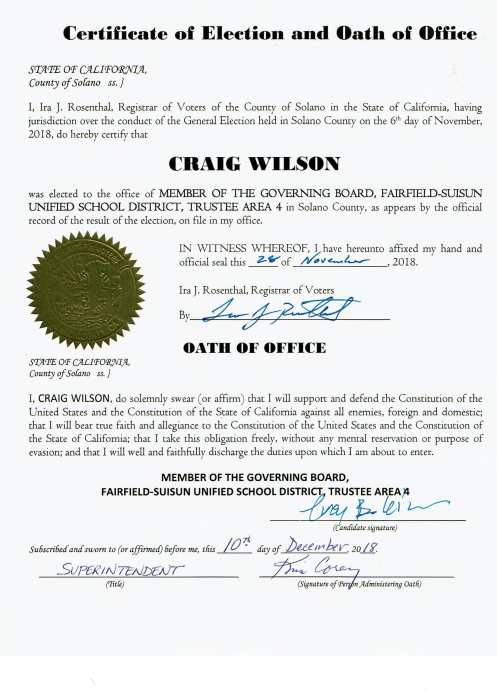
I was sworn in tonight, along with two other (re-elected) trustees, before the semi-annual dinner meeting of the Solano County School Boards Association at Solano College.
I didn’t get a selfie (others got pics, not sure if I’ll wind up with a copy), but I got a nice certificate (below) after reading the oath (also below) administered by Superintendent Kris Corey.

Flash update: Selfie kindly provided (just now) by colleague and Board President David Isom (from left: Isom, Superintendent Cory, myself, and wife Gayla). Thanks, David!

The rest of the meeting was uninteresting by comparison, though I learned about adult education efforts in the county. (The dinner, provided by a caterer, was good, though!)
I’m looking forward to another event tomorrow night. When I get my calendar properly linked, you’ll be able to see my future events.
Today (Dec. 4th, 2018) I had a scheduled orientation with several departments at the district office, from 8:30am to noon. First I sat down and listened to an introduction by the various union officials (Angie Avlonitis and Kim Morgan from the manager’s association, Ronnie Harrow from the psychologists association, Nancy Dunn from the teachers association, and Michael Minahen filling in to tell me about the support and clerical unions). There was little time for interaction, but I learned a few basics I hadn’t known. Next I listened to a slide show detailing the operations of the various business offices from Director of Fiscal Services Laneia Grindle. Next I received a slide show about the department of Administrative Services and Community Engagement by Executive Director Tim Goree. Then I sat down for a presentation on the Human Resources department by Assistant Superintendent Rob Martinez and Director Michael Minahen. Next I was shown a slide show about the educational services department, led by Assistant Superintendent Sheila McCabe and accompanied by Director of Secondary Education Kristen Witt, Director of Elementary Education Cindy Brown, Director of Student Services Angie Avlonitis, Director of Special Education Dorothy Rothenbaum, Director of Curriculum, Instruction and Assessment Melissa Farrar, and Director of English Learners and Instructional Support Howard Kornblum. Lastly, I met with Superintendent Kris Corey and talked about several subjects, including Thursday night’s board meeting agenda, the budget process, and interaction between board members and the superintendent.
Talk about a whirlwind tour! I want to sit down and further digest the information that was given me. (As well as paper versions of these slideshows, I was given links to online versions of them), so I can begin to get a sense of who does what in the district. I realize my job is not to be involved in any of these details, but if I can get familiar enough with them, I will be able, as part of the entire board, to make good decisions on behalf of the community.
I sat down and studied this week’s meeting agenda last night, and realized I am overwhelmed at the thought of voting on the 35 items (by my count) on the agenda, as well as receiving all of the information reports (hundreds of pages of information – here’s a link to the agenda start page, which has links to all of the sub reports). I’m starting to realize this job has a large number of “rubber stamp” functions, which rely on the expertise of the employees. The agenda and meeting system allows the board to raise a red flag at any point or pull an item for more explanation or even debate and input from the community, but most of the business is simply approving the recommended actions. There are occasionally items that require public input, and we are the voice of the community when we vote (after receiving input and comments from the community at large) but there aren’t many of those. (But when they arise, they’ll be intense, as I’ve noticed as a community member myself – things like budget cuts or other controversial subjects.)
Luckily I’ve got a bit of a reprieve from the responsibility of voting: I won’t be sworn in until Monday night (Dec. 10, 2018) at the fall dinner meeting of the Solano County School Boards Association, to be held at Solano College, so I’ll just be an audience observer at Thursday’s regular semi-monthly board meeting. My first votes will probably be at the January meeting.
#meetings #reflections
Phew – I’m exhausted. (Actually, I’m starting to recover, because this is written the next day as I’m starting to bounce back, but I sure was exhausted at the end.)
Saturday (Dec 1, 2018) was a half-day event, being the tail end of the three-day (four-day for newbies like me) event.
For the first session, I chose the one called “Toolbox for Mindful Governance,” and it turned out to be a promotional program for the in-depth training series for board members, called “Masters in Governance.” (Like an hour-long advertisement with testimonials.) I’m wary of advertisements, but this one sold me – I’ll be looking for ways to enroll. Each of the four people on the panel told of their evolution as a board member (and the particular challenges each faced within their school board), and I became convinced that board success is determined largely by the preparation, skill and unity (of goals) of the entire board. I want that, and I want our board to be successful in directing the district. I hope we can find common ground for our goals. If we can, we’re likely to have strong influence and thereby serve the community.
If not, well, at least we’ve got a strong superintendent and district employees and teachers, and the ship will be sailing well without the elected leadership team’s firm direction. They’ll make sure it meet state standards. But I’d rather be part of a team that shapes the district according to local values and priorities – I see that is the purpose of having a governing board. Why else elect resident lay trustees to oversee?
That’s our proper primary job (as I see it): to develop a consensus of community priorities and direct the professionals to incorporate them. It’s their job to use professional skills and standards to achieve them (as well as the state-level goals), and our job to astutely observe how well they meet all of the goals.
(There are other duties we have; may as well use the trustees to be the final venue of appeal, for example, and to formally adopt of policies and budgets. And since they’re there, have them/us perform ceremonial functions as well, like graduations, school concerts and open houses. But collectively directing the professional staff to adequately address local priorities is one of our most important duties, in my book.)
The final session, from 10-noon, was a combined look at the outlook for education in California. It depends a lot on state-level politics, and we heard from a panel of legislators and state-level analysts. I wan’t expecting to get much out of the last session (and I noticed the attendance was way down from the previous general session), but I got enough out of it to decide to do it again at the next conference a year from now.
Next year’s conference will be in San Diego; the year following in Anaheim, and the year after in San Diego again. I was able to include my wife, Gayla, as long as I could guarantee it would be at no cost to the district, but that will be harder next time. I’ll have to save up for her travel, because even though she did not participate in any of the conference events, she enjoyed holding down the fort in the nice hotel room during the day and accompanying us at evening events. She said she wasn’t bored (and we got to stop in at the Emeryville Ikea on the drive home!).
#reflections #training
This was an even longer day; out earlier, back later.
For the first session, I started with one (on data), dipped into another (on policies) before settling into a third (on communication strategies). For the second session, I chose one on “Parent Engagement” and discovered, one by one, that three other Fairfield Suisun board members had likewise chosen it. (We changed seats and all sat at the same table.) At lunchtime, located some others and joined the general discussion before returning to the general session (where we all sat together, per custom). Last session was about the Janus decision, then out to dinner, then home.
Conversations I enjoyed were with Board Member Bethany Smith (about PTA involvement), Tim Goree (about journalism and community metrics) and Board Member Joan Gaut (and husband Dave, a former board member, about district goals and board processes).
I’ve got a lot to learn about what our district does; will be looking for ways to contribute.
#training #informal #reflections
Longer day today. I left at 8am, didn’t get back in the room until 8pm-ish.
The first session was the one with presenters from our school district. On the presenters stand were Superintendent Kris Corey, Assistant Superintendent Sheila McCabe, Board Member Bethany Smith and Fairfield-Suisun Chamber of Commerce President Debi Tavey. (Helping pass the microphone to audience members was Executive Director of Administrative Services and Community Engagement Tim Goree.) I was proud to learn what our district has done with its community partnerships, which they’ve named the Inspire program (here’s a link to some information and a video.) But the value isn’t only what the students experience; it’s also the collaborative relationships they’ve built with employers large and small around Solano County. The program is spreading to neighboring communities, and I noticed keen interest from many of the 100-plus districts in the room (from all over California). I learned Board Member Smith helped create the program several years ago, which is now a model for other communities who want to replicate it.
The second session was on collaborative relationships between districts and their unions. The presenters, which included a superintendent and the teachers union bargaining chair, talked about building trust and pursuing shared interests, even if it means creating novel solutions. Two books they praised are “The Thin Book of Trust; An Essential Primer for Building Trust at Work” and “Having Hard Conversations.” I carefully put those in my wish list.
At lunch I ran into and visited with Board Member Joan Gaut (while we lunched at Chipotles). We talked about advocating in behalf of students and the fundamental roles of school board members.
The next session (a general session, with probably more than a thousand attendees) was by nationally known author Charles Duhigg, author of the book “Smarter Faster Better: The Transformative Power of Real Productivity.” I was stimulated by his talk, and enjoyed the stories he used to illustrate his ideas (including one about the original stage play of West Side Story).
Afterwards I visited with Board Member Jonathan Richardson. I appreciated getting to know him, and he shared ideas about how to act as a board member and the annual goal-setting process. I told him of one of my long-term goals of “improving ways that the district tells its stories.” (As a substitute teacher, I frequently learn of notable positive things happening throughout the district, little of which receives public attention. I’d like to find an effective way to share those things, so community confidence in its schools will increase.)
I then spent an hour on the convention floor, visiting exhibits and learning things. (I also bought a book.)
Lastly, I joined a small group (including my wife, Gayla) for an evening reception with dozens of other school districts.
I can only hope tomorrow’s sessions will be as engaging for me as today’s.
#informal #training
I’m attending the annual training conference of the California School Boards Association (CSBA) in San Francisco. The Wednesday session includes a daylong session for the 600-odd newly-elected school board members in California. Experienced board members start on Thursday.
After an introduction, the first session was a talk and slide show by the former executive director of CSBA, Davis Campbell. His topic was “The governance mindset,” and talked about transitioning from “campaigning” mode to “governing” mode. He said board members need confidence that they share core values about their purpose, and talked about “System Thinking” (like a car, a school district has many parts that must dependably work together), “Strategic Focus,” “Deep Learning” and “Manners.”
(I enjoyed his quote for the manners section, from a rulebook George Washington copied out by hand when he was 16 years old. I didn’t get the exact quoted section, but found a link to an article about them.)
The next session was led by a current board member and a retired board member, called “The First 100 Days: A Survival Guide.” They talked about policies, values and protocols, and showed an example of an annual board meeting planning calendar. While he was speaking, I located my copy of our district’s calendar, and when a superintendent from another district sitting near me noticed it, he was impressed enough to photograph it for his own use. It was more focused and easy to use than the example calendar on the slideshow. Go Fairfield Suisun School District!
The next session was led by a different board member and former board member, and focused on the California open meetings law, called the Brown Act, and meeting protocols.
The next session was presented by staff members of CSBA, describing resources and services provided by the association.
Finally, the two presenters from early in the day wrapped up and summarized a lot of the learning, and then the group dismissed to a “Networking Reception.” I visited with another new board member from a San Jose-area district, and we compared notes.
It was an interesting day, and I made lots of notes. It was very worth my time.
By the evening, a few other board members from Fairfield Suisun had arrived and we went out to dinner to socialize.
I look forward to tomorrow’s sessions when the main conference begins. Bonus: Around 10 pm my wife Gayla arrived to share the hotel room. I don’t think she’ll be able to attend the conference, but I think she looks forward to tagging along where she can (in the evening?) and enjoy the hotel room in the meantime.
#training
I spent several hours Friday and again Saturday (11/24/18) studying the school board bylaws and handbook. I have a printed copy and write copious annotations/questions as I read them, almost too many to track or even review. I have a few core issues I want to explore next week at the annual state school board members association conference, and I want to absorb as much as I can from the formal training as well. I’ve been told it’s overwhelming, so I want to be prepared to focus on the more important items (newly elected board member-related) and ignore much of the trade-show and vendor-related demands for attention. I’m told it’s also an important time for familiarity- and trust-building between board members, and as the newly-elected one, I need to get the benefits of that.
The other day I checked the Solano County Checked elections website and found that anyone can look up one’s own registration details and exactly when one voted. (I voted by mail, and it told me when my ballot was both sent to me and received back.) I’m impressed. During the campaign I had learned that it’s public record which community members voted in each election (although it’s cumbersome to obtain that info and involved a fee). For instance, I used that info to target my neighborhood walking and postcard mailing. But I didn’t know you could look up your own registration details in order to confirm that your vote was counted. You can also register or change your registration from the website. It feels empowering as an individual voter. I bet most people don’t know about that.
Ran into board member Joan Gaut when I got home last night; she was working with my wife on plans for a traveling choral group to provide a community concert next spring (details and publicity to come later). They gave me a few assignments related to the publicity materials and program, since I’m handy with basic graphics. This community group, “Music For Our Children,” meets monthly at Gordon’s Music and Sound and looks for ways to support public school music programs. I chatted with Joan about a few board member basics as I prepare for the conference. I often cross paths with Joan as a member of that group. (Come join us!)
Issues percolating in my mind include:
- how to communicate with community members and fulfill the responsibilities to them outlined in the bylaws. There are a lot of issues that we act on; how keep the community informed? There’s almost too much. Not only issues; also existing information on structure, procedures and programs – too much for even me to master, much less communicate broadly. (This website probably plays a pathetically small role in that, but I’ve got to start somewhere …)
- How to balance being an advocate/representative of the general public with my role as advocate/representative of the school district (when there’s a conflict, whose side do I take, fundamentally?).
- How to balance the board’s role as an oversight entity for the superintendent with the board’s role as a collaborator with the superintendent to make progress toward district goals. How maintain proper boundaries for those two roles?
- How to satisfactorily submit to the will of the board as a whole (I’m only one of seven, and have no authority as an individual) while also developing initiatives and looking for ways to influence them for changes I think would be valuable.
- How to balance behind-the-scenes work with the need to “do our business in front of the public.”
- How to project and build confidence as a representative of the public while also revealing/acknowledging the complexities of the system and its need for constant improvement.
#informal #reflections
I ran into retired PE teacher Claudia Wilde at the library (she volunteers with the “Friends of the Library” group) and she was interested in giving me background on physical education and the gradual change to K-8 schools (versus elementary and middle schools) in the district. We also talked about the sometimes disagreement between music and PE programs (a current issue) and the changes before and after the great recession of 2008. (I was chagrined to hear: she referred to one of her early teaching assignments in 1974 – that was when I was a freshman at Fairfield High School!)
(Here’s a link to a photo of Claudia in the Daily Republic.)
I said my ideal would be to get a dedicated revenue stream to fund supply and support needs in the extra-curricular programs (art, PE/athletics, music, others?) so that there wouldn’t be an eternal tussle between priorities in the general fund (the main operating budget).
I would also like a mechanism to measure student engagement and motivation as a result of participating in the extra-curricular areas, then we could adjust the funding in each to match the results as they are manifest in student lives. We systematically measure academic results, but I’d like to measure extra-curriculars as a magnifer/multiplier, to see how much they increase student commitment and achievement in the academic areas (reading, writing narrative reports, history, math & real-world problem-solving).
She said that to best understand the dynamics behind historical changes in the district (school boundaries, closures & realignments, the differences between each side of the freeway, “equity”), one would need to talk to the old-timers in the district, who have watched things unfold over several generations. There are still pockets of deep knowledge in various places and departments, she said.
She also mentioned the perceptions of real estate agents and home buyers, which may not be fully reflective of facts on the ground, but constitute a reality of their own which we need to factor into our efforts to balance and allocate. She gave me a few specific examples, which were new to me. I’ll be watching to become aware of currents of public opinion relating to specific schools, so that if they are inaccurate, we can change them. (If the perceptions are accurate, we’ll just deal with them as we do.)
I hope we, as a school district, are able to find a way to hear from the pockets of wisdom as we participate in inevitable further changes. I’ll be looking for ways to connect those who are most motivated (energetic, interested, free time or wide influence) with those most knowledgeable. Ideally I’d host periodic community forums on long-term issues such as these, and help shift public attention from hot-button current topics to long-range solutions that build a community identity and reflect broad values.
That’s what I envision as a proper role for a school board member.
#informal #longrangeissues
Even though I won’t be sworn in for a few weeks, I’m told some of the laws apply immediately upon election (Gov. code 54952.1, for instance). Except for voting, I’m learning that the mechanisms proceed as if I’m already a full board member (information flow, meeting schedule, responsibilities).
Today I received my “school assignments” for this year, a handful of schools where I am the assigned representative for public events, kind of a ceremonial designation (Cordelia Hills Elementary, Dan O. Root Health & Wellness Academy, Green Valley Middle School, Rodriguez High School, and Early College High School). I happened to be assigned as a substitute teacher at Rodriguez, and the principal invited me to briefly introduce myself at the after-school faculty meeting.
Afterwards, I attended the board orientation meeting, where all of the board members told about their involvement with education and reasons for being on the board, and we reviewed the “Nuts and Bolts” of board service. This was gratifying to get a personal angle on the other board members, outside the formality of a regular meeting.
Finally, I attended the Facilities Subcommittee meeting (as an observer) and learned about construction and improvement projects underway.
There are a lot of moving parts to a school district. I’m slowly becoming familiar with some of them.
Met yesterday (Fri Nov. 9) informally with Nancy Dunn, pres. FSUTA (teachers union) at Subway near Travis and Texas, on my way home after substitute teaching.
My recollections/discussed:
- Need for community input on school issues, perhaps an easy-to-use mechanism for non-involved people or a larger pool of involved people?
- Need for informal get-togethers of varied involved people (such as ourselves), to build familiarity among us and hope that increased trust will follow
- Hope to meet again periodically (monthly?), even if no issues present themselves (meet next in January some time); I would be comfortable including more people (perhaps I’ll get the “calendar” function on this website active, so I can post ahead of time where to meet me)
- Agreed I need to follow the lead of more experienced board members as I learn the role
- Shared a view of my role with “constituents”/citizens who may approach me with concerns: As well as refer them to the super. (instead of taking on their concern), in all cases I would listen and hear what they are saying. In some cases I would explain how they could use their voice to propose changes (not through me) using existing mechanisms. In rare cases I would determine (privately) to develop or promote a new mechanism to accommodate similar concerns.
- Showed my interest in eventually being available as a guest speaker to either classrooms or community groups, with an informative slide show available.
- Agreed that a long-term shared interest is to build public confidence in local public schools, so there will be little need or pressure to explore privatization schemes.
- Need to find a way for available, motivated, energetic citizens who want to get involved to become informed and make contributions. We need to harness that potential energy instead of ignore it and have it possibly turn against us.
- Noted the gradual nature of real change
 Craig Wilson, Board Member, Fairfield-Suisun School Board (personal website - not official, not speaking for district)